Primi piatti: pane frattau
Pane frattau demonstrates how much can be said about a place's culture with just a few simple ingredients. Slices of pane carasau, tomato sauce, grated cheese, and an egg are more than just a traditional recipe.
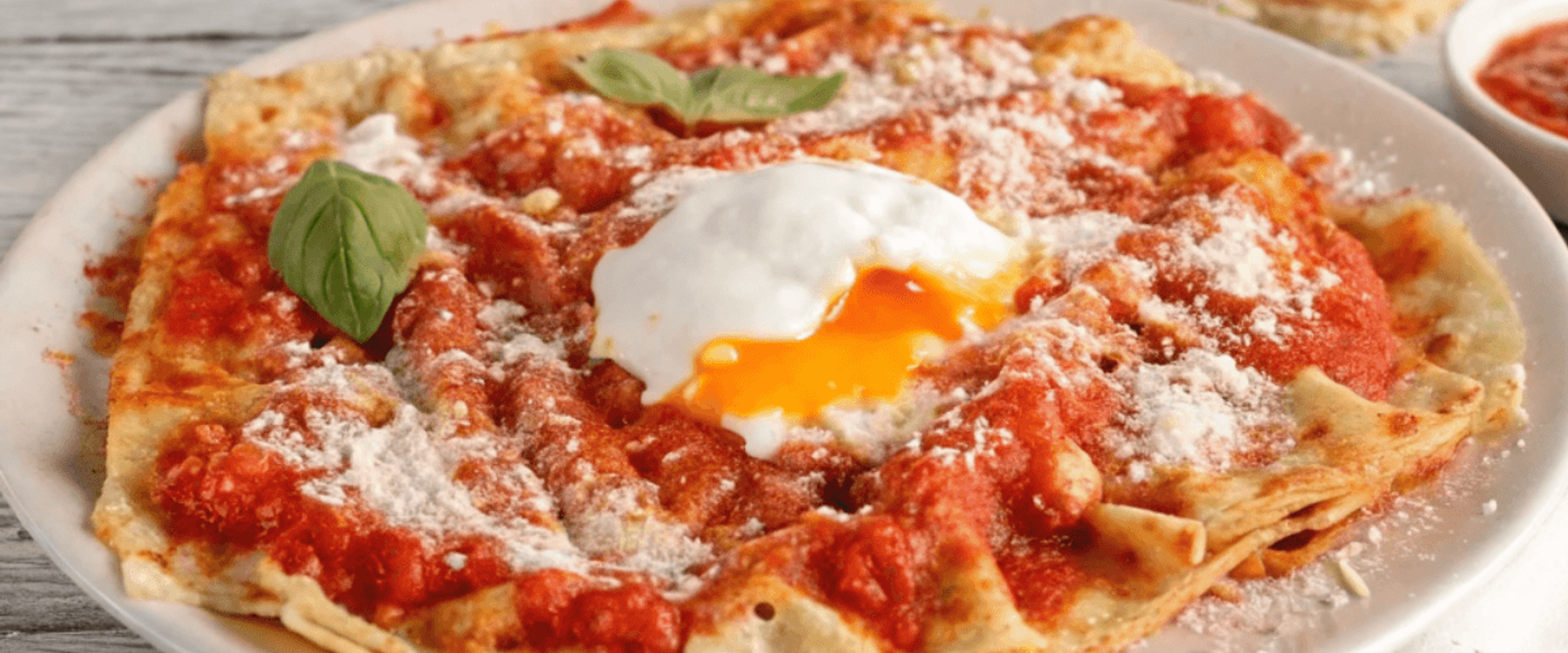
Today, pane frattau is one of the most recognizable dishes of Sardinian cuisine. Its roots are primarily linked to Barbagia—a region of Sardinia's mountainous interior—and the province of Nuoro. Over generations, a cuisine developed here, driven by the rhythm of work, the availability of produce, and the principle that food should not be wasted. It is difficult, however, to pinpoint a single moment when the dish as we know it today was created. There is no single, confirmed date of its origin, nor a single, canonical recipe.
And perhaps that is part of her character.
From Barbagia to Sardinian tables
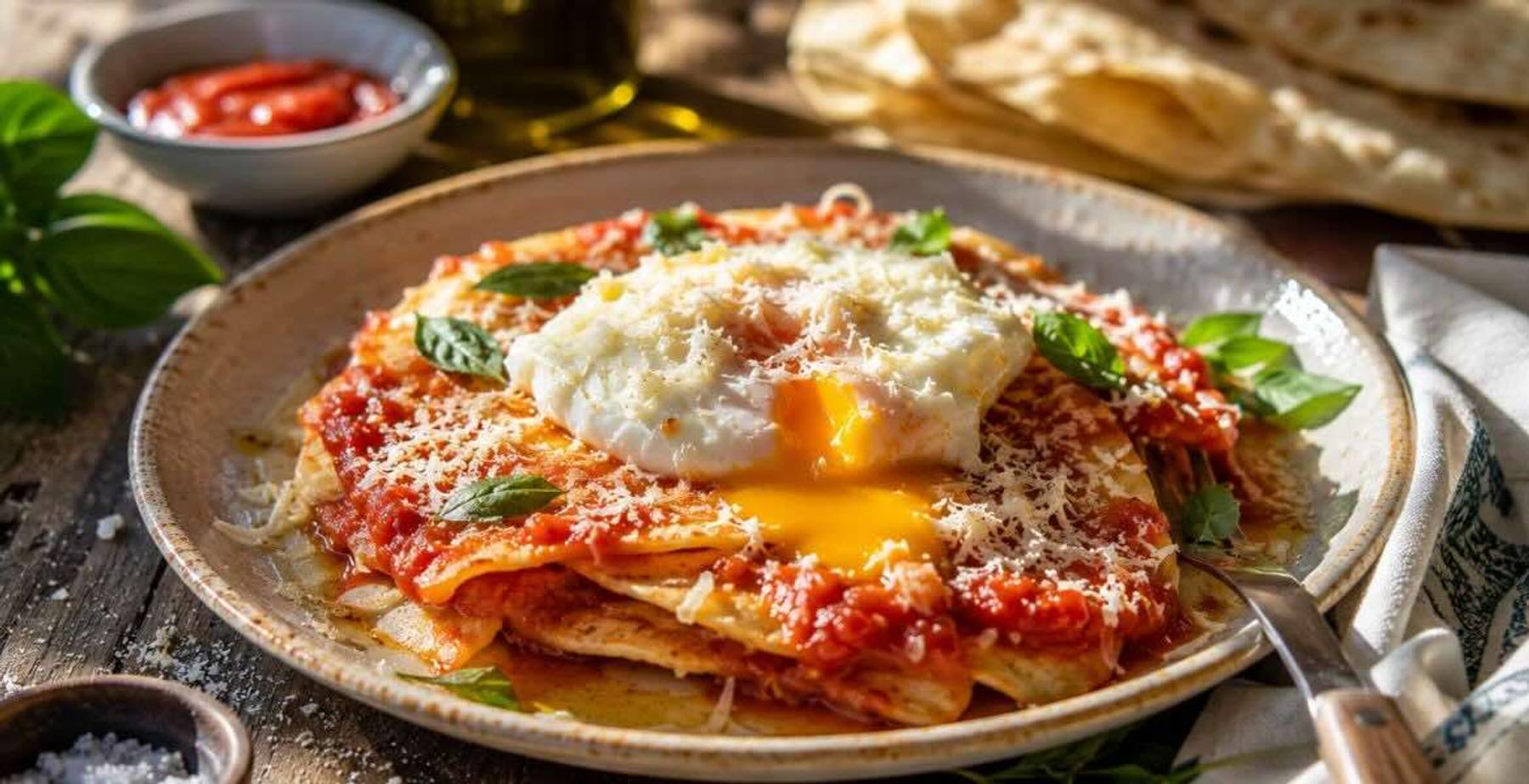
The Sardinian Autonomous Region includes pane frattau in the official list of traditional gastronomic products of the island, citing the province of Nuoro as the area particularly associated with this dish. In its basic version, successive layers of bread are layered with tomato sauce and grated cheese, and the whole is topped with a poached egg.
The modern form is relatively easy to describe. It's much more difficult to trace the path that led to it.
The Story of Pane Frattau
It is strongly connected with the pastoral culture of Sardinia. Its earlier forms were supposed to be a way to use bread that broke during work or transport. Dry pieces of bread could be softened again with water or broth and combined with whatever was available.
This approach fits well with the character of the old country kitchen: the product was supposed to be durable, practical and able to be used in many ways. It wasn't about culinary creativity as we perceive it today. Reusing bread was simply a sensible solution, very practical in the difficult everyday reality of the island.
Details of this way of life are also preserved in the description of the Regione Sardegna. Shepherds took with them dry bread, water and a piece of cheese or sausage, stored together in a leather bag called taschedda. Once home, the broken bread could be softened and served with whatever else was on hand on the farm.
In this way, a simple product became the basis of a dish, which over time began to be enriched with additional ingredients.
Frattau or fratau?
The name itself also has more than one version. In Italian, the most common spelling is pane frattau, while in Sardinian, it is pane fratau.
Giovanni Fancello, a historian of Sardinian gastronomy, points out that, according to the rules of limba sarda comuna, the correct spelling is with a single "t." He also associates the word fratau with meanings referring to something grated, crumbled, or broken into pieces.
However, the double "t" is common in Italian today, and it is pane frattau that the dish is most often recognized as outside of Sardinia.
A dish with no simple story
Several stories have emerged surrounding the origins of pane frattau. One of the most striking links its birth to King Umberto I's visit to Sardinia in 1899.
According to this story, the women preparing the meal for the monarch acted quickly and used available ingredients: bread, tomatoes, cheese, and eggs. From a simple set of ingredients, a dish was created that later came to be known as pane frattau.
The royal couple Umberto I and Margherita's visit to Sardinia in 1899 did indeed take place. The couple visited Cagliari, Iglesias, and Sassari, among other places. However, there is no equally strong source evidence that pane frattau was created at that time.
Therefore, the story about the king should be considered a local tale rather than established fact. Moreover, Sardinian tradition itself leaves much room for variations. As La Nuova Sardegna notes, in the case of pane frattau, we can speak of several certain elements, but not of a single, indisputable story regarding its origin.
This is characteristic of many regional dishes. Their history rarely begins on a specific day or at a specific table. Much more often, it develops over the years, as available ingredients and cooking methods evolve.
Tomato comes later
One more detail clearly illustrates why the history of pane frattau cannot be confined to a single date.
The very idea of softening bread and combining it with other ingredients is much older than the dish's modern form. Giovanni Fancello points out that the tomato appeared in European cuisine relatively late. This means that the basic method of preparing similar dishes may have existed before the modern set of ingredients became obvious.
In ancient kitchens, bread often served a much more important function than just a side dish. It could be soaked, combined with cheese, eggs, or broth, thus creating a full-fledged dish. Pane frattau is part of this very ancient tradition, but its modern form is a product of Sardinia's later history.
Therefore, its origins should not be traced to antiquity. It is more accurate to say that the culinary concept on which pane frattau is based has a very long history.
One dish, several local versions
There is no single, universally accepted recipe for pane frattau. Variations appear in the preparation method, the type of cheese used, and the softening liquid.
Regional documentation allows the use of both water and broth, including broth made with sheep's meat. The type of bread can also vary. A particular example is the Gavoi variant, where pane fresa is used instead of pane carasau, and the dish is paired with Fiore Sardo cheese.
This is important because it demonstrates that traditional regional cuisine doesn't always follow the lead of contemporary cookbook authors. Rather, it resembles a set of rules that can be adapted to the location, season, and produce available on the farm.
This is why pane frattau can taste slightly different in different parts of Sardinia, yet remain the same dish.
From shepherd's kitchens to restaurants
The transformation of pane frattau is an interesting example of how everyday cuisine is becoming part of a culinary heritage.
A dish whose logic stemmed from thrift and the need to use simple ingredients has now found its way into restaurants and gastronomy promoting local traditions. However, it remains based on the same principle: a small number of ingredients create a complete, filling dish, and characteristic of the place from which it originates.
This is not a story about luxury or a complex technique. Rather, its protagonists are everyday life, work, and the ability to manage food wisely.
Perhaps this is why pane frattau is so well-suited to Sardinia. Behind its contemporary, highly distinctive appearance lies a way of thinking that has been the foundation of local cuisine for centuries: using what is available, not wasting, and allowing the product to gain new life.
In this context, pane frattau is not just a traditional dish made with pane carasau. It is a record of a way of life—preserved in the simple combination of bread, tomato, cheese, and egg.
And the story of this dish reminds us that in cooking, "simple" very rarely means "ordinary."
Sources
- Regione Autonoma della Sardegna, Prodotti della gastronomia—official documentation of traditional Sardinian gastronomic products.
https://files.regione.sardegna.it/squidex/api/assets/redazionaleras/660e9cb2-9ef6-4570-9227-507fcceb5b7e/8.-prodotti-della-gastronomia.pdf - La Nuova Sardegna, Pane fratau, quattro certezze, il resto è fantasia—a text about the origin of the dish, its name and different versions of its history.
https://www.lanuovasardegna.it/regione/2020/10/23/news/pane-fratau-quattro-certezze-il-resto-e-fantasia-1.39455140 - L'Unione Sarda, Il pane fratau con una T, nato in fretta e furia per ingolosire re Umberto I—an article concerning the legend related to Umberto I.
https://www.unionesarda.it/cultura/il-pane-fratau-con-una-t-nato-in-fretta-e-furia-per-ingolosire-re-umberto-i-c752snqu - La Nuova Sardegna, La prima visita nel 1899: Umberto I—a text about the visit of Umberto I and Margherita to Sardinia in 1899.
https://www.lanuovasardegna.it/tempo-libero/2019/11/02/news/la-prima-visita-nel-1899-umberto-i-1.37827107 - Taccuini Gastrosofici, Giovanni Fancello, Pane frattau—a post on the history and name of the dish.
https://www.taccuinigastrosofici.it/ita/news/contemporanea/pani/pane-frattau.html - La Cucina Italiana, Pane frattau: la ricetta sarda col pane carasau—a contemporary description of the dish and its culinary context.
https://www.lacucinaitaliana.it/storie/piatti-tipici/pane-frattau-ricetta-origine/